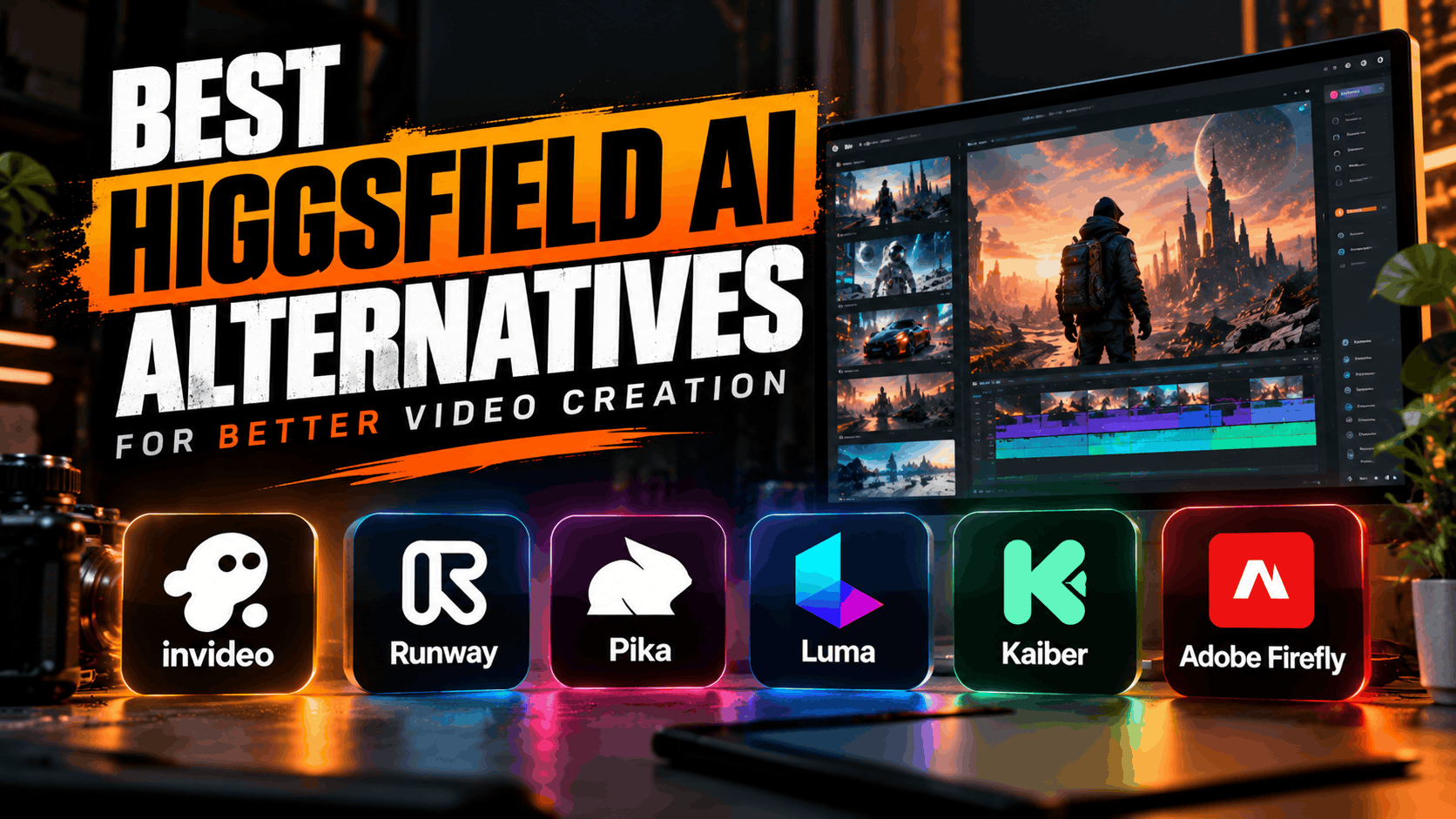
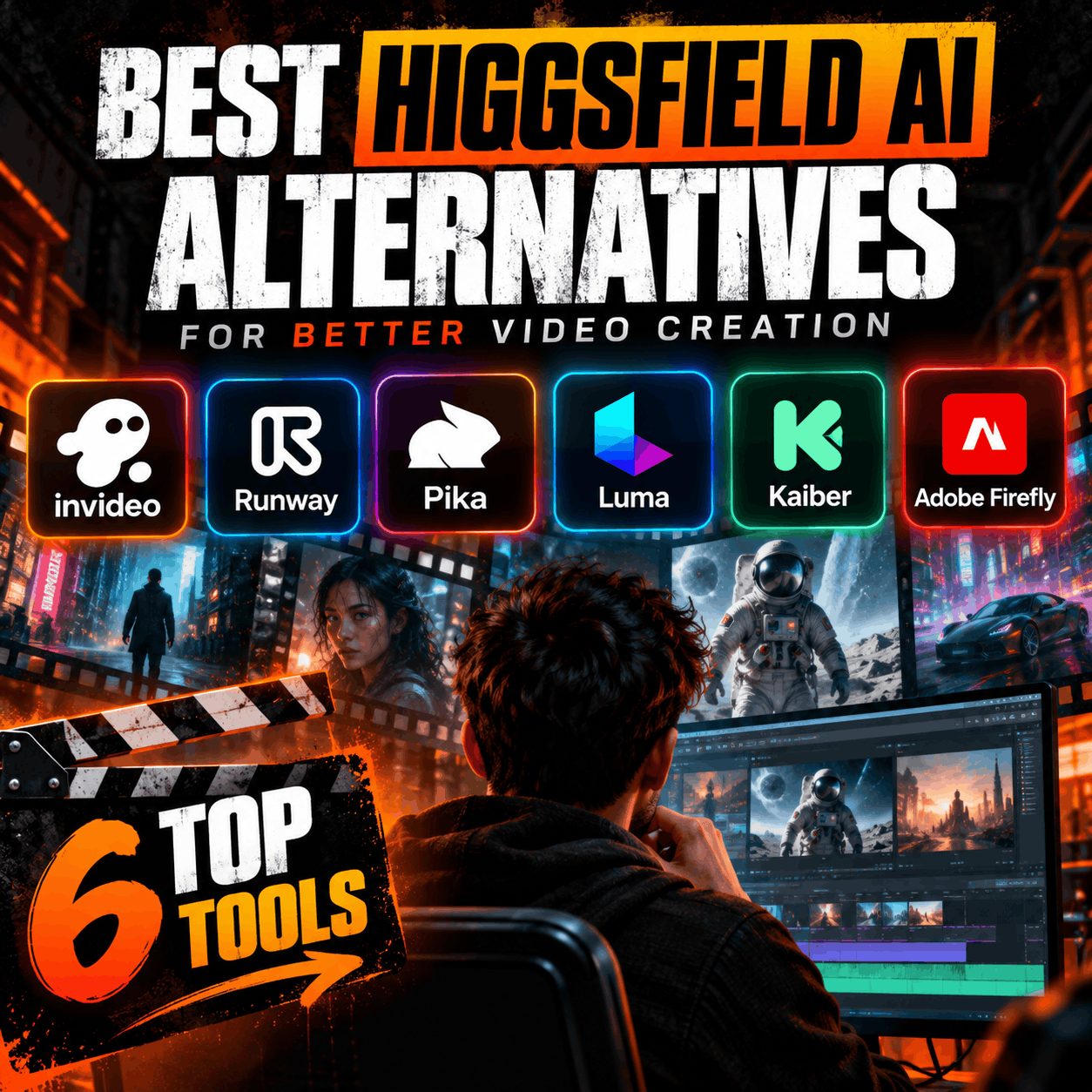
Higgsfield is a multi-model AI video platform built for short-form social creators, aggregating models like Kling, Seedance, Veo, and Sora into one workspace alongside its own Cinema Studio for shot-by-shot narrative breakdown, Soul Cast for character and brand consistency, and Click-to-Ad for turning a product URL into ad creative. It's reached real scale, with more than 20 million users and a reported $1.3B valuation, and it genuinely covers a lot of ground in one subscription. People look for an alternative less because Higgsfield is broken and more because of fit: its 200+ features and app library take real time to learn, its higher-tier and enterprise pricing isn't published transparently, and a creator who wants a narrower, more predictable tool, or one built around deeper project memory for longer narrative work, can be better served elsewhere. This guide compares six alternatives on generation quality, consistency across shots, workflow depth, and pricing clarity.
invideo — An AI filmmaking agent that plans, generates, and remembers a whole project (Best Overall for Consistent, Multi-Shot AI Video)
Runway — Cinematic generative video with professional editing tools (Best for Gen-Series Quality and VFX Workflows)
Pika — Fast, playful clips with signature effects (Best for Quick Stylized Social Clips)
Luma Dream Machine — Smooth, physically plausible motion (Best for Motion Quality)
Kaiber — Stylized, music-synced animation (Best for AI Music Videos)
Adobe Firefly Video — Commercially safe generation inside Creative Cloud (Best for Teams Already on Adobe)
Each platform was judged on four criteria: generation quality (how coherent and usable the output is without heavy cleanup); consistency (whether a character, product, or style holds across multiple shots and sessions, not just one clip); workflow depth (does the platform sit inside a larger project with memory and editing, or hand back a single flattened clip); and pricing clarity (is the real cost obvious, or buried in credits and unpublished enterprise tiers, the way Higgsfield's own top-tier pricing often is).
|
Tool |
Best for |
Key feature |
Starting price |
|
invideo |
Consistent, multi-shot AI filmmaking |
Project-lifetime memory plus 200+ models routed per shot |
Free manual editing; paid tiers from $17/month billed annually |
|
Runway |
Cinematic generative video and VFX workflows |
Gen-series video models plus professional editing tools |
$15/month (Standard) |
|
Pika |
Quick, stylized social clips |
Pikaffects and fast turnaround |
Free; paid plans from about $8-10/month |
|
Luma Dream Machine |
Smooth, physically plausible motion |
Ray3 model tuned for motion quality |
Free; Lite from about $10/month |
|
Kaiber |
Stylized, music-synced animation |
Style transfer tuned for music videos |
Free; Starter $10/month |
|
Adobe Firefly Video |
Commercially safe generation inside Creative Cloud |
Text-to-video and image-to-video, Premiere Pro integration |
Free tier; Standard $9.99/month |
invideo is built around invideo Agent, which plans, generates, and edits a complete video from a script, treatment, or plain-language brief rather than producing one isolated clip at a time, much like Higgsfield's own Cinema Studio aims to do. It routes each shot to the right model from a library of more than 200, including Veo, Sora, and Kling, and writes an optimized prompt for that model automatically.
It also opens that project to outside help: invideo supports letting you edit videos using AI agents such as Claude, ChatGPT, Claude Code, Codex, and Cursor, which connect over MCP and work on the same browser timeline you're watching, each with its own cursor alongside yours.
The agent's core advantage over a single-clip generator is project-lifetime memory: characters, locations, costumes, and style are stored once and held consistent across every shot and session. On the independent Physion-Arc 1.0 benchmark, a prior version of invideo Agent ranked first of seven AI video agents overall, with a score of 72.4 across 100 cinematic prompts. Two caveats apply: its lead over runner-up Runway Agent 2.0 was the narrowest in the field, and it carried the highest celebrity-resemblance risk of the seven on a separate safety scan.
Best for: Creators and teams making multi-shot, character-consistent AI video who want transparent, published pricing rather than Higgsfield's opaque higher tiers.
Where it falls short: Because the agent processes a large amount of project context to keep continuity, it can be slower than a single-clip generator built for speed alone.
Pricing: Manual editing is free; paid plans start at $17/month billed annually.
Runway helped define this category with its Gen-series models and remains a strong pick for cinematic quality and VFX-adjacent work: video editing, character video, and professional export formats sit alongside its generation tools in one workspace. Its own Agent 2.0 turns a brief into campaign assets conversationally, with ad variants, localization, and format reframing built in.
Pricing is per-editor rather than a flat team rate, so a multi-person workspace adds up faster than a single-subscription platform like Higgsfield or invideo.
Best for: Editors and marketing teams who want cinematic generation alongside professional VFX and editing tools.
Where it falls short: Per-editor billing scales quickly for teams, and the Standard plan's credit allowance is small enough to exhaust in a single real production session.
Pricing: Standard 15/month(144/year), Pro 35/month(336/year), Unlimited (formerly a separate tier) runs higher for uncapped generation.
Pika is the simplest on-ramp in this list: a straightforward interface, a generous free tier of a few hundred credits, and "Pikaffects" — one-click transformations like inflating, melting, or exploding a subject — that give a clip a distinct look without any prompt engineering. Generation is fast enough to iterate several times in a single session.
It doesn't attempt Higgsfield's breadth of apps or invideo's project memory, and clip length and output quality trail higher-end competitors.
Best for: Quick, stylized social clips where a fun effect matters more than narrative consistency or feature breadth.
Where it falls short: Shorter clips and lower motion quality than higher-end competitors, and no memory to keep a subject consistent across shots.
Pricing: Free tier with limited monthly credits; paid plans run from about $8 to $10/month up to roughly $95/month for the highest tier.
Luma's Ray3 model is tuned specifically for motion quality: objects move, collide, and settle in ways that read as physically grounded rather than warped or gliding. That's a narrower but genuinely strong specialization compared with Higgsfield's broader, multi-model, multi-app approach.
Pricing is usage-based rather than a flat monthly fee at the entry level, and clip length tops out shorter than some competitors.
Best for: Creators who prioritize realistic motion and physics over stylistic breadth or a large app library.
Where it falls short: Clips run shorter than Runway's or Higgsfield's, and usage-based pricing makes monthly cost harder to predict than a flat subscription.
Pricing: Free tier available; paid plans start around $10/month (Lite), with usage-based options scaling up from there.
Kaiber built a niche that Higgsfield's social-first, commercially-polished output doesn't really target: AI-animated music videos and stylized visuals synced to audio, with style transfer that applies a consistent look across a sequence. For a musician or artist who wants a distinctive visual treatment rather than realistic footage, that focus shows.
It isn't trying to compete with Higgsfield or Runway on photorealism or ad-ready polish, so expectations should be set around style rather than a brand-safe, camera-realistic result.
Best for: Musicians and artists making stylized, music-synced AI animation.
Where it falls short: Not built for photorealistic footage or multi-shot narrative consistency, and the Pro tier is priced well above most competitors at a similar generation count.
Pricing: Free tier available; Starter $10/month, Creator $29/month, Pro up to $149/month, Visionary custom.
Firefly's video model is trained to be commercially safe for licensing reasons, a meaningful difference for brands and agencies wary of generation trained on scraped web content, and a different trust proposition than Higgsfield's third-party model aggregation. It covers text-to-video and image-to-video, and integrates directly with Premiere Pro's Generative Extend, so a generated clip can extend or patch real production footage rather than living as a separate file.
Credits are the recurring complaint: each generation attempt, including failed ones, draws from a monthly allowance that can run out faster than the plan price suggests.
Best for: Brands and agencies already in Adobe's ecosystem who need licensing-safe generation tied to Premiere Pro.
Where it falls short: Clip length tops out at five seconds per generation, and the credit system can make real monthly cost less predictable than the sticker price.
Pricing: Free tier with daily limited generations; Standard $9.99/month (about 20 five-second clips), Pro $19.99 to $29.99/month, up to Premium at $199.99/month for unlimited generation.
Need a consistent, multi-shot AI film or series with transparent pricing → invideo
Want cinematic generation alongside professional VFX and editing tools → Runway
Want a quick, stylized social clip → Pika
Care most about realistic, physically plausible motion → Luma Dream Machine
Making a stylized, music-synced video or animation → Kaiber
Already work inside Adobe Creative Cloud and need licensing-safe generation → Adobe Firefly Video
Is Higgsfield actually bad, or is this just about finding a better fit? Higgsfield is a genuinely large, capable platform — 20+ million users, a $1.3B valuation, and a real breadth of features like Click-to-Ad and Soul Cast. The reasons to look elsewhere are usually about fit: its feature depth takes time to learn, and its higher-tier and enterprise pricing isn't published transparently, which matters more to some buyers than others.
What's the best alternative for keeping a character consistent across shots, like Higgsfield's Soul Cast? invideo's project-lifetime memory serves a similar purpose: characters, locations, and style are stored once and held consistent across every shot and session, so a change can propagate without regenerating the whole project.
Is there a free alternative to Higgsfield for AI video generation? Several have usable free tiers: invideo's timeline editor is free to use manually, and Pika, Luma Dream Machine, Kaiber, and Adobe Firefly Video all offer limited free generations.
Which alternative is best if Higgsfield's pricing feels too opaque? invideo and Runway both publish their tier pricing clearly on their sites. Higgsfield's Starter, Plus, and Ultra tiers are published, but its top-end agency and enterprise pricing is not, which is a common complaint in independent reviews.
Can any of these alternatives also generate ad creative from a product, like Higgsfield's Click-to-Ad? None of the six alternatives here replicate that exact workflow out of the box, though invideo's agent and Adobe Firefly's Premiere Pro integration both support generating and inserting product-focused footage into a larger ad project with manual direction.












 Premium Plans